Resources for Children

CHILDREN AND THE LABYRINTH
Labyrinths are being used successfully in schools, childcare centres, playgrounds, camps and other programs. Labyrinth activities support math, language, history, art and physical education.
They have been used to welcome new students, help children grieve losses, resolve conflicts, fundraise, celebrate graduations, and host community events.
Most notably, educators report that the labyrinth assists students to calm down, make transitions, and focus.
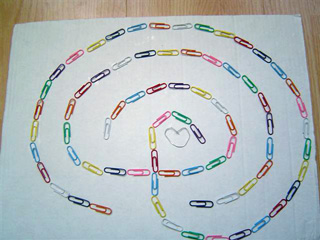
Can YOU make a labyrinth like these?


HOW TO DRAW A LABYRINTH OF THE SEVEN-PATH CLASSICAL OR CRETAN DESIGN


CHILDREN'S BOOKS
Bitsy's Labyrinth.
Andonian, Mary | Tualatin, OR, Good Thief Press, c2011
The secret path.
Butterworth, Nick | Harper Collins, 1994.
In search of Knossis: the quest for the Minotaur’s labyrinth.
Caselli, Giovanni | Peter Bedrick Books, 1999.
Mind-boggling mazes and loopy labyrinths.
Eid, Klaus | Prestel, 2004.
No wrong turns.
Eileen, Pamela | TYL pub., 2004.

The snow maze.
Mark, Jan | London, Walker books, 1992.
Labyrinths: can you escape from the 26 letters of the alphabet?
Mignon, Philippe | Firefly, 2002.
Labyrinth for kids.
Rossetta, Lani | Central Point, Oregon, Leihuni Entereprises, 2001.
Black ships before Troy.
Sutcliffe, Rosemary | London, Frances Lincoln, 1993.
BOOKS FOR EDUCATORS

Photo credit: Lois Hayes
108 ways to use labyrinths in schools.
Hancock, Gael | Labyrinthos, 2004.
Children and the labyrinth: liturgical and non-liturgical uses.
Kallstrom, Chrisine | Alternative learning environments, 2001.
Kids on the path: school labyrinth guide.
McCarthy, Marge | Labyrinth resource group. 2008. Villemaire, Lorraine, SSJ, MA
The Labyrinth experience: an educator's resource.
Sisters of St. Joseph of Springfield, MA., n.d.

